George Dunne
Clown in a CornfieldGeorge Dunne is Kettle Springs’ sheriff and one of the principal architects of the conspiracy meant to save the town by purging its younger generation. He presents himself as a reassuring guardian of public order, but his speeches expose a more dangerous principle: when law seems inadequate to his idea of what is right, he is willing to act beyond it. Quinn Maybrook kills him during the final confrontation, bringing his authority and his campaign to a violent end.
Identity and Public Authority
Quinn first sees George Dunne at the restaurant, where his physical presence makes the office of sheriff seem almost inseparable from the man. He is massive and visibly aged, with reddened, open pores, a thick rectangular gray mustache, a sheriff’s star, a belt, handcuffs, and a sidearm. His appearance strikes her as so fixed that she cannot imagine him younger. He tips his hat to Glenn Maybrook, then settles into the booth behind Quinn without waiting to be seated. The scene establishes a local authority who does not need to announce his power formally: his badge, familiarity, and command of space do that for him.
That authority also has a practiced warmth. After a tense encounter with high-school students at the restaurant has been defused, George Dunne returns to Glenn, claps a large hand on his shoulder, and greets him as the new doctor. Glenn looks uncomfortable, but tries to meet the sheriff in a professional manner. Dunne’s genial manner can smooth an encounter, yet his imposing presence remains; friendliness and intimidation coexist in his public persona.
Sheriff and Civic Crisis
At a town meeting about the Baypen investigation, George Dunne demonstrates how readily his official position can eclipse the mayor’s. When Cybil Barton asks about the case and the dropped charges against Cole Hill, he first says he cannot comment on an ongoing investigation and assures the crowd that those responsible will be brought to justice. He then shifts to an unofficial register, asking that the meeting recorder put down her pencil before he offers what he calls his personal view. The movement from formal restraint to a carefully staged disclosure lets him retain the appearance of lawfulness while steering public feeling.
He tells the crowd that legal authority and what is right may diverge, and suggests that the law may soon be insufficient to preserve Kettle Springs as its residents know it. He invokes community solidarity and says that Mr. Vern has discouraged certain students from attending the next day’s event. Dunne’s language turns a question about a specific investigation into an argument about the town’s identity and who belongs in its public life.
The speech draws force from the town’s losses. George Dunne points to Victoria Hill’s death the previous year and the recent fire at Arthur Hill’s factory, then links those griefs to Arthur’s diminished emotional and financial investment in Kettle Springs. He also names the town’s declining population and condemns young people for disregarding local history and heritage. Members of the PTA, City Council, and Neighborhood Watch respond with agreement. His account does more than mourn economic decline: it assigns blame to a generation and makes collective punishment sound like community defense.
George Dunne’s influence unsettles Mayor Harlan Jaffers. At the meeting, Dunne draws the crowd’s attention simply by moving to the front of the room, leaving Harlan’s attempt to call the meeting to order unnoticed. Harlan’s feelings toward him are mixed: he hates him, loves him, and envies him even more. Their rivalry is therefore not just a disagreement over procedure. Dunne possesses the public confidence and emotional command that Harlan wants, and uses it to redirect civic discussion toward his own agenda.
The Blighted-Crop Doctrine
The gap between George Dunne’s public assurances and his private justification becomes explicit in his exchange with Cole Hill. Dunne says that Cole and the young people who were present at the reservoir the night Victoria died are bad, whether they were born that way or made that way by phones, the internet, music, or social media. He dismisses the question of cause in favor of what he sees as the result. As the sheriff who investigated Victoria’s accident, he knows how closely Cole’s guilt is bound to the loss of his sister; he nevertheless turns that grief into evidence for a much broader indictment.
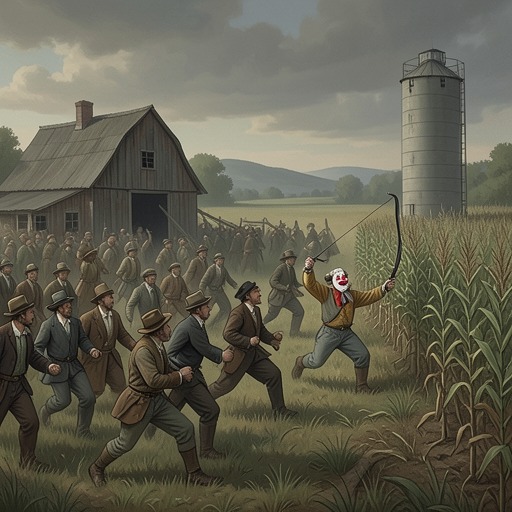
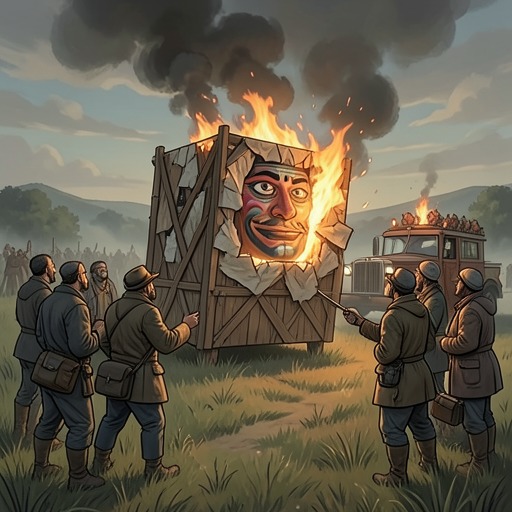
Dunne explains that indictment through agriculture. He calls the young people a blighted crop and compares them to fungus, beetles, or other scourges that spread unless a farmer cuts and culls them. In his analogy, the harvest may have to be burned, and the field left fallow for several seasons, to save the land. The metaphor converts people into a threat to be eliminated and presents mass violence as a practical measure of restoration. It also joins his public appeals to heritage and community with the conspiracy’s underlying purpose: protecting the town, in his view, requires destroying those he has designated as its corruption.
Cole challenges the logic directly, accusing Dunne’s generation of refusing to listen to young people while demanding a return to an idealized past. Dunne answers that Cole’s rudeness proves his point, then moves from the rationale to the practical means of the plan. The exchange reveals that his doctrine is not merely a heated speech or a political pose. It is the justification he uses for action.
Relationships and Conspiracy
George Dunne describes Arthur Hill as one of his oldest friends, despite their limited contact by phone. At the town meeting, he speaks of Arthur’s losses—the death of his child and the burning of his factory—as losses shared by Kettle Springs. He also argues that Arthur will not invest in the town as it now stands. Their friendship thus connects private bereavement and economic decline to Dunne’s vision of civic rescue. The later revelation that Arthur and Dunne’s plan involved twelve conspirators known to the FBI confirms that Dunne’s public rhetoric belongs to an organized effort, not a solitary outburst.
His relationship with Cole is shaped by the same history and conflict. Dunne investigated Victoria Hill’s death and knows that Cole regrets what happened at the reservoir. Rather than treating that regret as a reason for restraint, he uses Cole’s involvement in the night’s events to support his claim that an entire generation is bad. In this way, an individual tragedy becomes a weapon in his broader case against young people.
At the town meeting, Dunne also turns suspicion toward an unnamed minor when he says he has reason to believe that a minor was responsible for the explosives used in the parade. He declines to identify the person before charges are filed, but invites the crowd to draw its own conclusions. The suggestion intensifies the gathering’s anger while preserving a thin distinction between accusation and formal disclosure. It exemplifies his recurring method: he invokes the language of law, then uses insinuation and collective judgment to move people toward action beyond its limits.
Death and Legacy
Near the end, George Dunne is badly wounded and struggles down a metal staircase with his gun raised. His hand shakes; blood from the wound in his abdomen has run over his belt and streaked his trousers. He can barely focus on Quinn, yet still aims at her and begins to speak. Quinn fires before he can finish. His hat flies back, and he falls down the stairs, ending at her feet. The sequence makes the change in power unmistakable: the sheriff who once commanded a room and steered a crowd dies unable to control the final encounter.
The aftermath places his death within the larger failure of his intended rescue. Arthur Hill and George Dunne’s plan, carried out with twelve conspirators known to the FBI, did save Kettle Springs in one sense, but not in the way they intended or anticipated. The town’s population has been decimated; in the following days and weeks, news media, state and federal law enforcement, and true-crime documentarians arrive, bringing a temporary economic boost as visitors need places to stay and eat. George Dunne’s legacy is therefore a bitter reversal: a plan framed as preservation brings mass loss and transforms the town through the very catastrophe it was supposed to avert.